Madagascar
LIS
OpenELIS Global
Odoo
Ozone Analytics


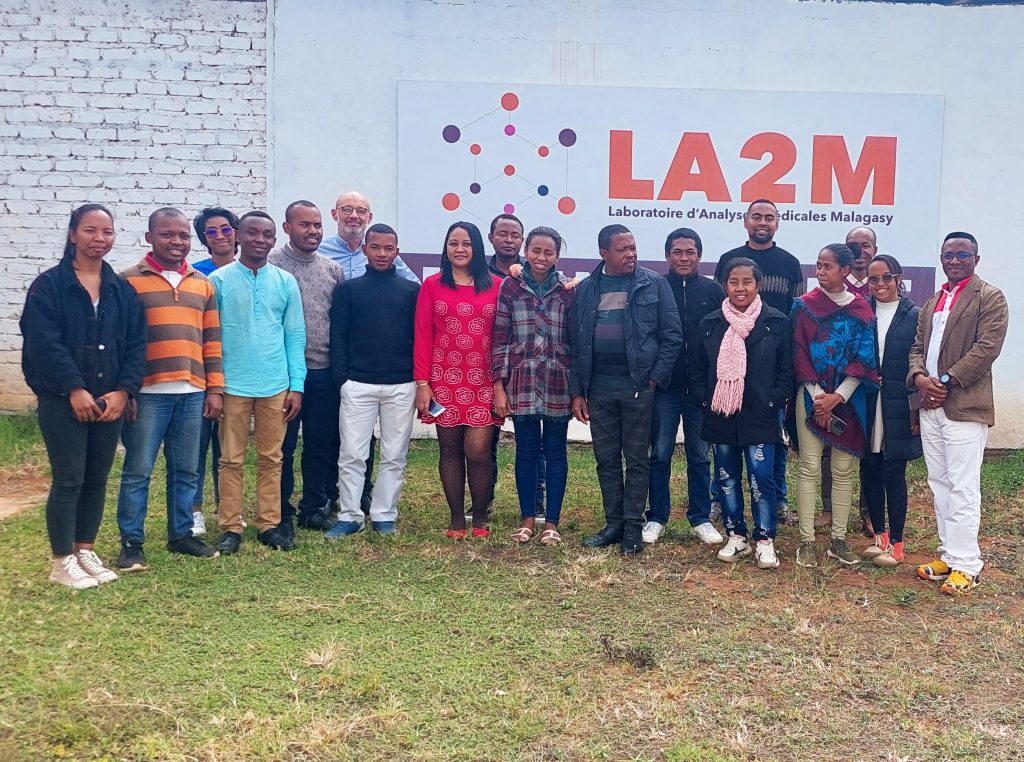
Madagascar's Ministry of Public Health set out to strengthen the digitization of its laboratory network through eSIL, an integrated laboratory information system designed to address immediate needs while providing a foundation for national scale.
Two Ministry stakeholders are central to the initiative. LA2M (Laboratoire d’Analyses Médicales de Madagascar) represents the laboratory métier and is the ultimate recipient of the work, defining the workflows and operational requirements that shape eSIL. DEPSI, the Ministry's digital and information systems counterpart, is central to its technical ownership and future evolution.
The initiative was made possible through funding from The Global Fund, with the UCP coordinating its operational implementation and STRIDES / FHI 360 supporting key ICT infrastructure needs.
From the outset, the Ministry chose to build eSIL around established Digital Public Goods and open-source technologies rather than developing another bespoke system.
Digitizing a laboratory network involves considerably more than installing laboratory software.
Beyond core laboratory workflows, eSIL needed to address inventory and supplies, analyzer connectivity for about 10 distinct laboratory analyzers, identity and access management, analytics and reporting, and interoperability with national systems.
The challenge was therefore twofold: put a comprehensive system into production quickly across nine laboratories scattered across this vast country while architecting it from the outset for horizontal expansion.
Sustainability was paramount. LA2M and DEPSI needed to progressively acquire the knowledge and capacity to operate, maintain and evolve the system themselves.
Rather than developing these capabilities from scratch, eSIL uses Ozone as the packaging, orchestration and interoperability framework connecting four key components of its ecosystem:`
Ozone packages and connects these applications so that each can focus on what it does best while collectively operating as eSIL, a coherent laboratory information system. Its interoperability capabilities also support integrations with laboratory analyzers using standards such as ASTM and HL7, as well as other national digital health systems.
Importantly, the underlying applications remain upstream products rather than project-specific forks. eSIL can benefit from their respective open-source communities while Ozone provides the common architecture through which the overall system can be deployed and evolved.
The first eSIL deployment encompasses nine laboratories across Madagascar, including LA2M Central and the laboratory of CHU HJRA in Antananarivo.
By standardizing how eSIL is packaged, configured and integrated, these sites establish a foundation for horizontal scale. Additional laboratories can progressively join the ecosystem by leveraging an existing standard national distribution rather than starting new implementation projects from scratch.
In parallel, knowledge and technical capacity are being progressively transferred to LA2M and DEPSI, coupling technical scalability with growing national ownership.
Within approximately one year from procurement, Madagascar moved from defining its requirements to putting eSIL into production across nine laboratories.
This was possible because the project did not begin with a blank sheet of paper. OpenELIS Global and the other applications already provided mature capabilities, while Ozone provided the packaging, orchestration, interoperability patterns and deployment machinery needed to bring them together.
The implementation could therefore focus on Madagascar's workflows, configuration, integrations, infrastructure and capacity building rather than developing foundational software from scratch.
eSIL demonstrates how Digital Public Goods, orchestrated through Ozone, can accelerate the path from procurement to production while preserving openness, extensibility and a pathway toward national ownership.
curl -s https://raw.githubusercontent.com/ozone-his/ozone/main/scripts/install-stable.sh | bash /dev/stdin
cd ozone/run/docker/scripts/
./start-demo.sh